Location labels and listings can leave distance, opening times and pokies availability unverified across Sydney and nearby areas.
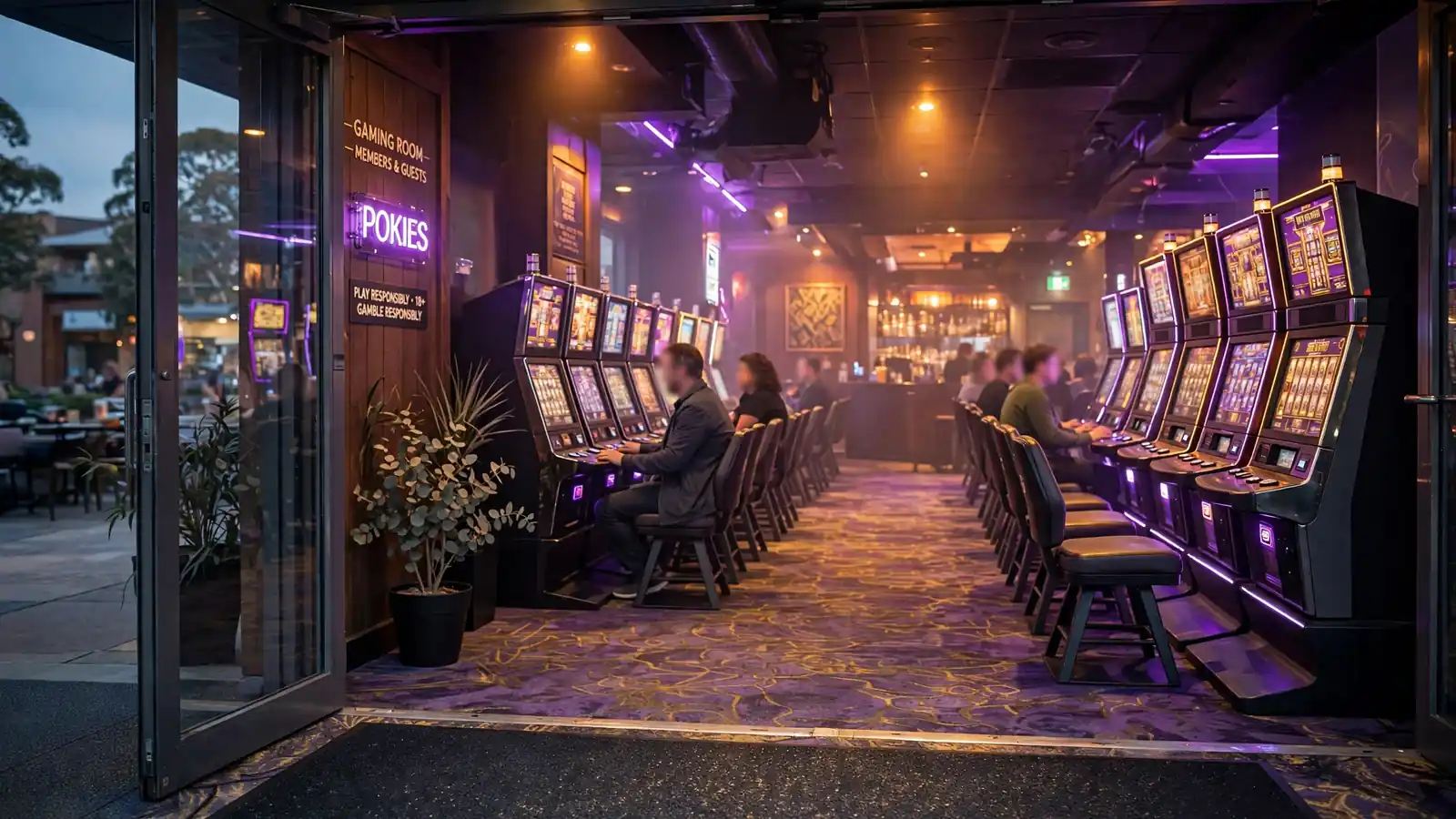
“Near me” looks precise on a screen. In practice, it is a loose label attached to a location estimate, a map result or wording in a venue listing. I learned not to treat that label as a promise. A result can appear relevant to someone in Sydney without establishing that a particular place is close to their actual position, open, or offering pokies.
That distinction matters across a large urban area. A listing associated with Sydney may be nowhere near the suburb someone has in mind. Even a result that names a familiar district can leave important details unclear: what point the distance is measured from, whether the route is practical, and whether the listing describes the place currently operating there. “Nearby” is a sorting term, not a confirmation.
The same caution applies when the starting point is a transport hub. A search for pokies around Sydney Airport may return results connected with the wider city or surrounding area; the wording alone does not establish a venue inside the airport, beside it, or within an easy walk. The airport reference is a clue about the searcher’s intended area, not evidence of a particular location.
Choosing pokies in Sydney for 2026 means finding an option that suits your preferences and checking its terms before you play. This list provides a concise reference to the available operator details.
LuckyVibe
LuckyVibe is listed with a Curacao Gaming Control Board licence, OGL/2023/176/0095, held by Hollycorn N.V.
GoldenCrown
GoldenCrown is listed with a Curacao Gaming Control Board licence, OGL/2023/176/0095, held by Hollycorn N.V.
Uptown Pokies
Uptown Pokies has operated since 2017 and lists a minimum deposit of A$20. Its stated licence is Curacao.
JustCasino
JustCasino is listed with a Curacao Gaming Control Board licence.
DragonSlots Casino
DragonSlots Casino is listed with a Curacao Gaming Authority licence, with Jumpman Gaming Ltd named in connection with it.
Vegaz Casino
Vegaz Casino lists a Curacao OGL/2024/1335/0780 licence and a minimum deposit of EUR 20.
Roby Casino
Roby Casino is listed with a Curacao eGaming licence, with Roby Games Ltd named in connection with it.
Kingmaker
Kingmaker lists a minimum deposit of A$30. Its stated payout times are about 90 minutes for crypto and 1–5 days for fiat.
Wild Tokyo
Wild Tokyo lists a minimum deposit of A$10 and a Curacao licence. Its stated payout times are 30–60 minutes for crypto and 1–5 days for fiat.
Thor Casino
Thor Casino is listed with a Curacao licence through Antillephone N.V. (Versus Odds B.V.) and a minimum deposit of EUR 20.
I used to see how quickly a broad location phrase could become a concrete expectation. A person would arrive with a result on a phone and assume the map had settled every question. It had not. The result might help identify an area to investigate, but it could not stand in for checking the venue’s own details or confirming that the location suited the trip. Search ranking is not a service guarantee.
There is also a difference between a place being geographically close and being practically accessible. A map may display a short straight-line distance, while the actual route involves a road crossing, a station exit, a long block or a change of transport. That is ordinary city navigation, but it matters when a search is being used to make plans. The pin is not the route.
Sydney-wide wording can blur distinct places together. A result for central Sydney does not automatically answer a question about the CBD, Central station or a particular suburb. Those names can appear together in a broad listing even when they refer to different points. The useful check is not whether a result contains the right city name, but whether its address and location match the intended starting point and destination.
“Best pokies in Sydney” can create a similar false sense of certainty. A prominent result may reflect how a listing is presented, not a verified comparison of nearby venues or their current availability. I would separate three questions that often get folded into one: where the place is, whether it is operating, and whether it has the facilities being sought. A location result answers none of those by itself.
Search wording can also combine places that do not belong together. A reference to Sydney and Victoria, for instance, may reflect an imprecise location entry rather than a clear destination. The more compressed the phrase, the less it says about the intended route or the venue. It is better read as a starting point for clarification than as a reliable geographic description.
The practical way to read these results is modestly: treat the map as a locator, inspect the address, and distinguish an area label from a confirmed venue detail. A result can narrow the geography. It cannot prove that a place is open, that pokies are available there, or that it is the nearest suitable option.
That is the limit. A pin is not a promise.
A Sydney address does not change the legal position on real-money online pokies. Under the Interactive Gambling Act 2001, companies cannot provide online casino games, including pokies, to people in Australia. No Australian licence has been issued for an online casino, so there is no locally licensed online casino option.
That distinction is easy to blur in promotional language. A site may describe itself as available to Australians or use familiar local payment terms, but availability is not the same as lawful Australian licensing. The law concerns the operator’s provision of the service. It does not create a domestic licensing route simply because a site accepts Australian customers.
Legal Status
Under the Interactive Gambling Act 2001, companies cannot provide online casino games, including pokies, to people in Australia, and no domestic licenses have been issued.
I learned to read the fine print before the headline. “Australian-friendly” describes a commercial choice, not a licence. That matters when a service is presented as an online equivalent of a Sydney venue: the wording can suggest local oversight that does not exist.
Some offshore casinos accept Australian players, but they are not Australian-licensed online casinos. If one refuses to pay winnings, the player has no legal recourse in Australia against that operator. That is the central consumer-protection problem: a dispute may be governed by the operator’s terms and the rules of another jurisdiction, with no Australian casino regulator able to resolve it as a domestic licensing matter.
A polished interface, local currency display or familiar brand language does not close that gap. Nor does a claim that a site is “trusted” establish that an Australian authority supervises its online casino service. The practical question is not only whether a game can be opened, but what remedy exists if the account is restricted or a withdrawal is withheld. Here, the Australian remedy is absent.
This is also why an online casino associated in name with Sydney should not be mistaken for a Sydney-licensed service. A search for online pokies near Sydney, or for real-money play on a phone, does not turn an offshore operator into a domestic one. Location words describe the intended audience; they do not establish regulatory status.
People may look for cashless pokies, high-limit play, or offers described as no-deposit bonuses. Those labels do not alter the underlying legal position. If the service is real-money online casino gambling offered to people in Australia, it remains within the prohibition on operators providing that service. A bonus does not make the activity a different kind of product, and a payment method does not supply a licence.
The same applies when the wording names a physical casino or another city. A venue name in an online offer is not proof that the venue operates the website, that the site is licensed in Australia, or that winnings are protected under Australian law. The name can be a marketing reference; the legal responsibility turns on who provides the online service and where the customer is located.
From the operator’s side, those distinctions are not cosmetic. They determine whether the service is being offered within a permitted domestic framework. From the player’s side, they determine whether Australian legal recourse exists if something goes wrong. In this market, those are not the same thing.
I would not treat “best-paying” language as evidence of protection either. A claim about a possible payout says nothing about whether an Australian authority licenses the operator or can compel payment. The legal position is plain: there is no Australian-licensed online casino, and an offshore operator’s refusal to pay cannot be taken to an Australian regulator as a domestic casino dispute.
The key separation is between access and protection. A website may be reachable and may accept a deposit, yet still sit outside Australia’s licensed online-casino framework. Those facts do not make the service lawful for the operator to provide, and they do not give the player an Australian route to recover withheld winnings. Reachable is not protected.
An “open” label is a lead, not confirmation that pokies are available at that moment. I learned to separate three things that are often compressed into one result: whether a venue is operating, whether its gaming area is accessible, and whether the information is current. A listing can answer one of those questions while leaving the others untouched.
That distinction matters when someone is planning around an early start or a late finish. A result suggesting that a Sydney venue opens early does not, by itself, establish that its pokies are operating then. Nor does a venue’s general opening information necessarily describe the hours of every part of the premises. Search snippets can be brief, old or drawn from a page that describes the venue as a whole rather than its gaming facilities.
A hotel pokies search has the same limitation. The word “hotel” identifies a type of place, not a confirmed schedule for its gaming area. A listing may show venue information without specifying whether pokies are accessible at the time being considered. Treating those details as interchangeable is an easy mistake. It is also the kind that turns a quick plan into a wasted trip.
I would check the venue’s own current information rather than rely on a short search preview. The useful detail is a clearly stated schedule that applies to the relevant area, not simply a general claim that the premises are open. If the page is unclear, contacting the venue directly is a more reliable way to settle the question than reading certainty into a vague listing. Even then, information can change, so the timing of the check matters.
“Open now” is particularly easy to overread. It may reflect the hours attached to a business profile, not a live confirmation of what is operating inside. A result can also remain visible after its underlying information has changed. I treat a timestamp, an explicit description of gaming-area hours and a direct confirmation as different levels of evidence—not as interchangeable badges.
Early-opening and late-opening searches deserve the same care. The phrasing describes the time a person hopes to play, not proof that any particular Sydney venue meets that need. No search wording can establish a venue’s schedule on its own. The check has to be tied to the named place and the specific area, on the relevant date.
There is a separate confusion around searches that combine opening times with payout percentage. Hours and returns are different questions. A venue’s schedule says nothing about the return setting of a particular pokie, and an advertised or quoted percentage does not establish when a gaming area is open. Combining both subjects in one result does not make either detail more dependable.
From the counter side, the wording that causes trouble is often the simplest: “open” sounds complete, when it may describe only part of the picture. A result can help narrow down what to verify, but it is not a substitute for a current, venue-specific answer. Check the right detail. Then make the plan.
Attention: An "open" label on a search result is only a lead and does not confirm that the gaming area is currently accessible or that the information is current.
“Best paying” sounds like a simple label, but it can hide two separate questions: which return setting is attached to a particular game, and what can be expected from any individual spin. Those are not the same thing. A return percentage describes a game’s theoretical performance across many plays; it does not promise that a session, or a particular player, will receive that share back.
A specialist review reports that some game providers let casinos choose between different RTP settings for the same pokie. Where that arrangement applies, the title alone does not establish its return percentage. The same game could therefore have different theoretical returns at different casinos. The setting is the relevant detail, not the game’s reputation, artwork or popularity.
That is why claims about the best pokies in Sydney need careful reading. A familiar title may be available in more than one configuration, and a broad claim that a game “pays well” does not identify which configuration is being discussed. Nor does a return figure, when one is disclosed, tell the whole story of how a particular session will unfold. It describes a long-run property, not a result scheduled for the next spin.
The mechanism behind each spin is separate. A Random Number Generator determines the outcome, and one spin does not depend on the result immediately before it. A run of wins does not make a loss due, and a run of losses does not make a win more likely on the next turn. I have seen the difference between those mechanics and the way people talk about them become blurred: a streak feels like a pattern, but that feeling does not alter the next random result.
This independence also explains why past outcomes are a poor guide to what comes next. A machine displaying a recent sequence is showing history, not a signal that predicts the next outcome. Likewise, a high theoretical return does not mean that a pokie is “due” to pay, or that it will return a set amount during a short visit. Long-run averages are not personal guarantees.
For Sydney casino pokies, the practical comparison is therefore narrower than the language of “best” suggests. The game name may be the same, while its RTP setting may not be. And even when the setting is known, it cannot remove the uncertainty built into each spin. The return figure describes one layer; randomness governs the individual result.
I would treat a headline about a best-paying pokie as incomplete unless it identifies the relevant return setting and makes clear what that measure does—and does not—say. Without that distinction, a percentage can look like a prediction when it is only a theoretical measure over many plays. It is not a forecast for a single session.
A search for pokies at Sydney Airport can sound like a venue description, but it is only a combination of place and activity. It does not establish that pokies are inside the airport, in a nearby building, or available to people passing through. The same distinction applies to searches for North Sydney. A location label can describe a broad area, an intended destination, or simply the words someone used to narrow a search.
A search result mentioning a landmark like Sydney Airport or an area like North Sydney describes a broad region or an intended audience, not necessarily a venue inside those specific locations.
I have seen how easily that distinction disappears in promotional copy. A heading names a landmark; a nearby result appears; the two are read as a single claim. They are not. A search result may point to a page that mentions an area without confirming a venue there. A map pin can be equally easy to overread if it is not checked against a current, identifiable venue listing.
“Pokies at Sydney Airport” might mean machines within the airport precinct, a venue somewhere in the surrounding area, or a general request made while travelling. Those are different claims. Without a clearly identified venue and a direct confirmation of its address and facilities, none should be assumed from the wording alone.
The practical distinction matters because airport names are used as landmarks over a wide area. A result that includes the airport in its description does not, by that fact alone, establish that the venue is inside the terminal or within walking distance. I would treat distance, access and the actual premises as separate details to verify—not as implications supplied by a place name.
The words “pokies in North Sydney” are also not proof that a particular local venue has machines. North Sydney can function as a broad geographic label, while a result may refer to an address outside the area or use the name for general relevance. The name alone cannot settle the boundary or the venue’s facilities.
Sydney City searches create a similar ambiguity. A result that uses “Sydney” broadly should not be mistaken for a CBD address, and a CBD reference does not establish that a particular club or premises offers pokies. The wording is a starting point, not a verification.
The same caution applies to searches about maximum cash payouts on pokies in Sydney. That phrase does not establish a universal payout ceiling or a figure that applies across venues. Any stated amount would need to be tied to a specific machine, its rules and the relevant conditions. Without those details, a maximum presented as a Sydney-wide fact would be misleading.
I prefer to separate what a location phrase suggests from what a venue can actually confirm: the premises, its address and whether the relevant facility is there. That is less tidy than a confident map label. It is also more reliable.
Names are not evidence.
A search for pokies at Crown Sydney bundles a name, a place and an expectation into one phrase. That wording can point towards a venue-related answer, but it does not establish what is available there. A familiar brand name is not evidence of machine availability, a dedicated pokies room, particular facilities or current operating conditions.
I have seen how easily a label becomes a claim once it is repeated. A page says “best pokies room”; the phrase sounds like a comparison has been made. But “best” has no fixed meaning without stated criteria and reliable evidence behind them. It might refer to the range of games, the room itself or a visitor’s preference. Those are different things. A ranking with no clear basis is still a ranking.
The distinction matters when a search names Crown Sydney specifically. The words may reflect what someone hopes to find, not a confirmed description of the place. Repeating them as a heading or recommendation can quietly turn an assumption into apparent fact. That is how a search result acquires more certainty than the underlying information warrants.
A useful account separates what the name indicates from what would need independent confirmation. The name can identify the subject of the search. It cannot, by itself, settle whether pokies are available, what form any gaming area takes, or whether a particular room deserves a superlative. Those claims need current, venue-specific evidence. Without it, the careful answer is narrower.
No implied endorsement. No invented detail.
This is also why “Crown Sydney casino pokies” should not be treated as a complete description. Search phrasing often compresses several assumptions: that the named place offers the activity, that the activity is accessible under the expected conditions, and that the result can be judged against alternatives. Each assumption needs its own support. A polished page or confident snippet does not supply that support merely by sounding specific.
The same caution applies to recommendations framed around the “best” room in Sydney. A useful comparison would need a disclosed basis and information that can be checked. Without those, a superlative is promotional language rather than a finding. I would rather leave a gap than fill it with an attractive but unverified description.
There is a practical difference between identifying a search subject and making a venue claim. The first can be done from the wording alone. The second requires evidence about the venue itself, not inference from the words people use to find it. For Crown Sydney, keeping that line visible is more useful than dressing uncertainty up as a recommendation.
A venue’s machine count is not just a measure of its scale. It can determine what oversight has to be present while the pokies are operating. A report by regionriverina.com.au describes a requirement for venues with more than 20 gaming machines to have a dedicated Responsible gambling officer (RGO) on duty during operating periods, starting on 1 July. That is a staffing obligation tied to machine operation, not a claim that every venue has the same arrangements.
The distinction matters when comparing Sydney venues. A prominent name, a large gaming floor or a busy location does not, by itself, establish what staff are on duty or how a venue handles signs of gambling harm. The operational question is more specific: whether the required role is covered while machines are running, and whether staff have a process for escalating concerns.
The same report describes a requirement for venues to maintain a gambling incident register. It is intended to capture occurrences, including situations where a patron’s behaviour suggests they may be at risk of gambling harm or already affected by it. In practice, that turns an observation into a record rather than leaving it as an informal exchange between staff. The register is an accountability mechanism. It does not, on its own, tell the public how an individual venue responds to every incident.
From the other side of the counter, I learned that written procedures matter most when a situation is uncomfortable. Staff need to recognise when behaviour warrants attention, know who is responsible for acting, and document what happened consistently. A named role and a formal register provide structure. They are not a guarantee of a particular outcome.
Venues with more than 20 gaming machines must have a dedicated Responsible gambling officer (RGO) on duty and maintain a gambling incident register to record patrons at risk of harm.
That is why “best pokies venue in Sydney” is a poor shorthand for operational quality. A list or a polished room description cannot establish whether oversight is active during machine hours or whether concerns are recorded. Nor should the existence of a rule be confused with proof that a specific venue is meeting it. Those are separate questions.
For people weighing up pokies venues in Sydney or the CBD, responsible-gambling oversight is best understood as a matter of venue operations, not machine performance. The officer requirement applies according to the stated machine threshold and operating period; the register requirement concerns recording incidents and indicators of harm. Neither says anything about a pokie’s returns, and neither turns a venue into a recommendation.
The less visible work is the point. Staff presence, escalation and record-keeping are part of the operating framework, not promotional features. Paperwork matters.
A claim that pokies are available around the clock is stronger than a claim that a venue opens late. It means the machines can be used at every hour, including overnight, not simply that a building has long trading hours. Those distinctions matter: a venue may have separate operating areas, and the hours of a bar, restaurant or other service do not establish when its pokies are operating.
I have seen how a broad label can travel further than the detail behind it. “Open 24 hours” sounds definite, but it can refer to a business, a service desk or a part of a property rather than gaming machines. The wording alone settles none of that. A current listing can also lag behind changes in trading arrangements, so a result that looks current is not the same as confirmation from the venue.
The same caution applies to “open now”. That phrase depends on the time the information was checked and on what the listing means by open. A venue’s doors being open does not necessarily confirm that pokies are running at that moment. Nor does a listing that says “24 hours” establish uninterrupted machine access unless it clearly refers to gaming operations.
For Sydney, a claim about around-the-clock pokies should therefore be treated as a specific operating-hours statement, not inferred from a venue’s general opening hours. The useful distinction is between a place being open and pokies being available. Without that distinction, a confident-looking result can answer the wrong question.
There is also a practical limit to what static hours can tell anyone: they cannot prove live status. Hours may be published as a routine schedule, while temporary arrangements or operational changes affect what is happening at a particular time. A venue’s own current information is a better reference for its stated schedule; direct confirmation is the more reliable way to establish what is operating at that moment.
I would read “24-hour pokies” as a claim needing precise confirmation, not as a convenient shorthand for late trading. The wording must identify the gaming operation itself and apply to the relevant time. Anything less is a general opening-hours claim, not proof of all-hours pokies access. Short distinction.
A search for pokies in Sydney’s CBD, or at clubs in the city, does not establish that a particular club has machines or that it is the right fit. I have seen how quickly a venue name can become a recommendation once it appears in a list. The more useful distinction is between a location claim and the controls available where gambling takes place.
Deposit limits, loss limits and session time limits are standard responsible-gambling tools. They address different points in the same cycle: how much money can be put in, how much can be lost, and how long a session can continue. Self-exclusion is a separate measure, intended to restrict access rather than simply set a boundary on spending or time.
The wording matters. A limit is a control, not a prediction of what a session will cost, and it does not make gambling harmless. From behind the counter, I learned that a tool has practical value only when its terms are understood and it can be used before play becomes difficult to stop. “Flexible” may sound reassuring; what matters is what the setting actually controls and whether it can be changed.
Self-exclusion should not be confused with a deposit or session limit. It is meant to prevent access, while limits set boundaries within permitted play. BetStop applies only to Australian-licensed operators and does not bind offshore sites. That distinction matters when considering the reach of any exclusion measure; a register’s name alone does not establish that it covers every service or venue.
For CBD club searches, responsible-gambling controls are a more concrete point of comparison than the word “best”. They do not verify that a club offers pokies, and they do not establish that one venue is superior. They describe safeguards, not a ranking.
The practical test is straightforward: identify which control is being discussed, what it limits, and where it applies. Deposit, loss and session limits manage different aspects of play; self-exclusion aims to block access. None should be treated as a guarantee of safety. Clear terms. Real boundaries.
“Parkes” can point to more than one place, so a request combining it with Sydney does not identify a single suburb, town or venue. It may mean a place called Parkes within the wider Sydney area, Parkes elsewhere in New South Wales, or simply a search phrase assembled without a precise map location. The wording alone cannot settle which one.
That distinction matters before drawing any conclusion about pokies. A result associated with Sydney does not establish that a venue is in Parkes; a result for Parkes does not establish that it is in Sydney. Nor does a venue appearing in a map or directory entry confirm that pokies are available there. Location labels can be broad, duplicated or based on how a listing has been categorised.
I have seen how quickly a location assumption can become a venue claim. Someone sees a familiar place name beside a city and reads the two as a confirmed address. They are not the same thing. A search result is a clue to investigate, not proof of proximity, machine availability or current operating details.
The practical way to resolve the ambiguity is to identify the intended Parkes first: check the full address and the map location, rather than relying on the place name in a heading. Then assess any venue information separately. An address can clarify where a business is listed, but it does not by itself confirm that pokies are offered or that the listing is current.
“Best pokies in Sydney” also does not make the Parkes reference more precise. It expresses a preference, not a location or an independently established ranking. Without a clear place and verifiable venue details, there is no sound basis for treating a result as a recommendation.
Keep the two questions separate: which Parkes is meant, and what is actually confirmed about a venue there. That avoids turning an ambiguous label into a confident claim. No guesswork needed.
Yes, Australians can legally play on offshore sites that accept them, but those operators are not licensed in Australia. The law targets operators, and there is no Australian-licensed online casino.
Each spin is an independent random event determined by a Random Number Generator. However, some providers let casinos choose between different RTP settings for the same game, so the return percentage can vary between casinos.
It is the amount you must bet before bonus winnings can be withdrawn. For example, a $500 bonus with a 40x requirement means $20,000 in bets; if the requirement applies to a $500 deposit plus a $500 bonus at 35x, it means $35,000.
There is no Australian-licensed online casino, and an offshore operator is not supervised as a domestic casino. If an offshore site refuses to pay, Australian players have no legal recourse in Australia against it.
E-wallets such as Skrill and Neteller are popular for their speed, but the available withdrawal options vary by site. Check the casino’s withdrawal terms, and remember that some sites impose weekly or monthly withdrawal limits.
Compare the wagering requirement with the bonus and any withdrawal cap: a $500 bonus at 40x requires $20,000 in bets, while 35x on a $500 deposit plus a $500 bonus requires $35,000. Free-spin winnings may also be capped, so check the promotion terms before accepting.