A practical guide distinguishes poker availability from event notices and covers accommodation, access, dining and other Hobart casino queries.
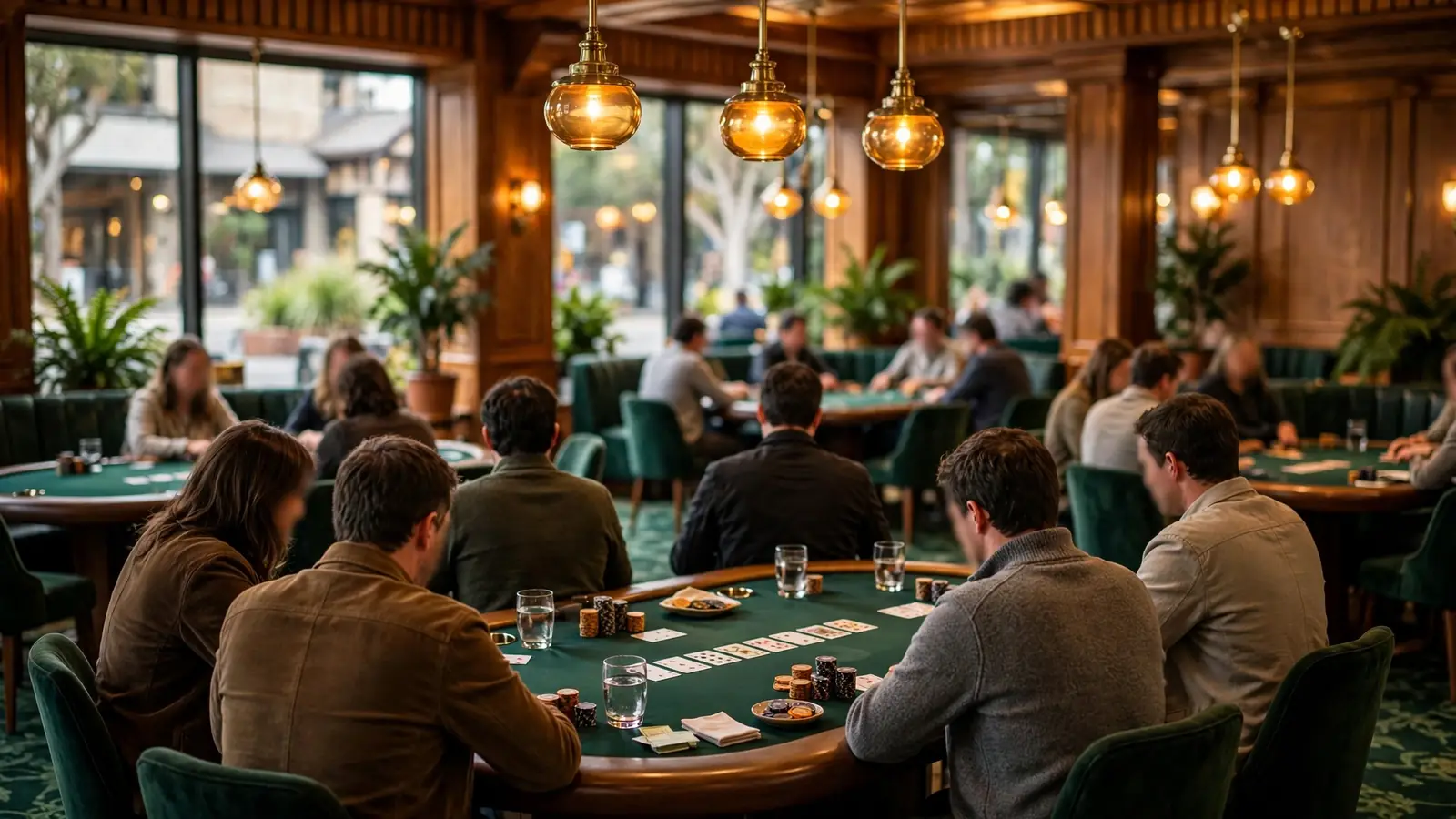
Poker-room listings, tournament notices and ordinary casino-room searches describe different things. A poker room is a gaming area; a tournament is a scheduled format of play; “rooms” can also mean accommodation. A sports bar is a separate venue feature. One label does not establish the presence of the others.
I treat a poker listing as useful only when it gives operational detail: which game is being played, whether the session is cash play or a tournament, and when the information was last updated. A venue name beside the word “poker” is not a schedule. Nor does a tournament page, by itself, show that a regular poker room is open for unscheduled play.
The distinction matters because tournament information is time-sensitive. A dated event notice can describe a past session, while a general poker page may not say whether games are running on a particular day. “Open today” is a separate question again: it concerns the venue’s current operating status, not whether a poker table is available. I would not read one as proof of the other.
For a tournament, the practical details are the format, registration arrangements, start time, entry conditions and any stated prize structure. Without those, “poker tournament” is just a category, not enough information to plan around. For cash games, the useful details are the game variant, whether tables are operating and how players are seated. These are the details that separate a usable notice from a broad description.
Poker also differs from pokies. Poker is played against other participants under the rules of the game; pokies are Electronic Gaming Machines with outcomes generated by software. The distinction is not merely terminology. A page about poker does not confirm anything about machine play, and a general casino listing should not be taken as evidence of a particular poker offering.
I have seen promotional wording do a lot of work while saying very little. “Action” may sound like a promise of a lively table, but it does not specify a game or a session. “Tournament” can sound like a recurring fixture, though the word alone gives no frequency or future date. Details matter more than the label. No schedule, no assumption.
The word “rooms” is particularly easy to misread. In a poker context it can refer to a dedicated playing area; in a hotel context it means accommodation. A casino-room search does not settle which meaning is intended, and neither meaning confirms the other. Poker facilities should be assessed on their own information, not inferred from a hotel description.
The same caution applies to a sports bar. A bar listing does not establish that poker is available, while a poker reference does not establish a bar or its hours. These are distinct facilities, and their operating arrangements may differ. Even when a venue has several services under one roof, the details for one service do not automatically carry over to another.
For a visit centred on poker, the key question is therefore not simply whether a venue is described as a casino. It is whether current, venue-specific information identifies the game and the session being sought. If the only detail is a broad promotional phrase, it cannot answer whether a particular tournament is on or whether a poker table is operating at that moment.
There is also a difference between a venue being open and a particular activity being available. Opening hours do not guarantee a poker game, and a tournament notice does not establish general opening hours. Both require their own current information. I keep those checks separate rather than treating a single result as confirmation of everything.
Poker is gambling, not a dependable way to recover losses. Increasing stakes after a loss can deepen it; a session budget should be set in advance and kept separate from money needed for ordinary expenses. The game’s format may change, but that arithmetic does not. No recovery system.
A stay described as “near the casino” and a casino accommodation deal are not the same offer. The first is a location claim about a place to sleep; the second suggests a link between lodging and the venue, such as a bundled rate or an added benefit. In booking copy, those ideas can sit side by side even when the accommodation is arranged independently. I treat them as separate claims until the terms make the connection clear.
For accommodation near a casino in Hobart, the useful comparison is practical rather than promotional: where the property is, how the quoted rate is structured, and what the booking includes. A nearby address does not, by itself, establish that a property is partnered with a casino or that its rate depends on casino activity. “Close” is a selling word. The actual location and the booking conditions do the work.
A claimed casino accommodation deal needs the same close reading as any other package. The headline rate may apply only to selected dates or room types, while an included benefit may have its own conditions. The important distinction is between a price that is simply available from a lodging provider and an offer explicitly tied to a casino visit. If the connection is not stated in the booking terms, it should not be assumed.
I have seen promotions sound broader in a banner than they are in the checkout details. A package can be valid only under particular booking conditions, and a benefit may not be interchangeable with cash or usable at any time. The label “special” says little on its own. The conditions decide.
When comparing independent stays, it helps to separate the lodging decision from the entertainment decision. First establish what the accommodation booking covers: the room, any included services, cancellation conditions and the final price shown before payment. Then consider whether the venue itself has published a separate offer. Combining the two in one mental calculation can make an ordinary room rate look like a casino benefit.
The same caution applies to promotions described as casino-related. A promotion should identify who provides it and what is required to claim it. A lodging provider may advertise a deal near a venue without the venue sponsoring it. Conversely, a venue-linked package should spell out the booking route and the benefit in its own terms. Those are different commercial arrangements.
For a Hobart stay, proximity is best assessed from the property’s actual address and the route between it and the intended destination, rather than from a broad neighbourhood label. Map descriptions and booking-site labels can compress geography into a few words; they do not establish a partnership, a shuttle service or a particular travel time. Those details need their own confirmation.
I would also keep the booking record: the rate description, the conditions displayed at checkout and any confirmation that names an included benefit. If the advertised offer and the confirmed reservation do not match, that record makes the disagreement specific. A vague recollection of a banner is harder to resolve.
The phrase “casino accommodation” can therefore describe several different things: lodging in the surrounding area, a property promoted alongside the venue, or a genuinely linked package. They should not be treated as synonyms. For a stay near a casino, the sound comparison is between the accommodation’s stated location and its written booking terms—not an assumption that proximity carries a discount or a casino benefit.
Choosing a casino option from Hobart calls for checking the details that are available about each operator. This list provides a concise reference to help you assess the options.
LuckyVibe
LuckyVibe lists a Curacao Gaming Control Board licence, OGL/2023/176/0095, held by Hollycorn N.V.
GoldenCrown
GoldenCrown lists a Curacao Gaming Control Board licence, OGL/2023/176/0095, held by Hollycorn N.V.
Uptown Pokies
Uptown Pokies has operated since 2017 and lists a minimum deposit of A$20. Its stated licensing is Curacao.
JustCasino
JustCasino lists a Curacao Gaming Control Board licence. No further operator details are provided here.
DragonSlots Casino
DragonSlots Casino lists a Curacao Gaming Authority licence associated with Jumpman Gaming Ltd.
Vegaz Casino
Vegaz Casino lists a Curacao licence, OGL/2024/1335/0780, and a minimum deposit of EUR 20.
Roby Casino
Roby Casino lists Curacao eGaming licensing under Roby Games Ltd.
Kingmaker
Kingmaker lists a minimum deposit of A$30. Its stated payout speeds are around 90 minutes for crypto and 1–5 days for fiat.
Wild Tokyo
Wild Tokyo lists a Curacao licence and a minimum deposit of A$10. Its stated payout speeds are 30–60 minutes for crypto and 1–5 days for fiat.
Thor Casino
Thor Casino lists a Curacao licence from Antillephone N.V. (Versus Odds B.V.) and a minimum deposit of EUR 20.
“Casino hotel” can describe several different arrangements: a hotel operated by a casino company, a hotel connected to a gaming venue, or a hotel simply marketed alongside one. The label alone does not establish which arrangement applies. For Hobart, the distinction matters because a room listing and a casino listing can appear together without proving that the gaming venue operates the accommodation.
I have learned to treat the connection as a practical detail, not a flourish in a property description. A genuine hotel-casino relationship should be clear in the operator’s own description: who runs the hotel, whether it is physically connected to the casino, and what facilities or services belong to each business. If those points are blurred, the phrase may be doing more work than the facts behind it.
Room searches raise a separate issue. “Casino hotel rooms” can suggest rooms on site, but it does not establish room types, views, accessibility features, check-in arrangements, or whether accommodation is available at all. Those details need to come from the hotel’s own booking information. I would not infer them from a casino name, a photograph of a building, or a third-party page that groups hotels by location.
Genuine hotel-casino relationships should be clear in the operator's own description regarding ownership, physical connection, and facility responsibility.
The same discipline applies to claims of a package or special rate. A room offer may be issued by a hotel rather than by a casino, and its conditions may be separate from entry to the gaming floor. The name of a casino in a booking headline does not, by itself, establish a bundled stay, a complimentary benefit, or a direct booking relationship. Read the actual terms, not the promotional shorthand.
Hours are another point that can be mistaken for a hotel feature. A casino’s operating hours, if published, would not automatically tell anyone when a hotel’s reception operates, when check-in begins, or how late a guest can arrive. Likewise, a reference to shows would describe entertainment rather than accommodation unless the listing explicitly connects the two. Keep the services separate. Small distinction, real consequence.
For a Hobart stay described as casino-associated, the useful questions are straightforward: what is the named accommodation provider, what is its relationship with the venue, and which business is responsible for each advertised service? A clear answer makes it possible to distinguish an attached hotel from an independent property using the casino as a location reference. Without that clarity, the safest reading is the narrow one: a room is being offered, but the wording does not prove a casino-operated hotel.
That is also why a property name should not be treated as confirmation of a particular room or facility. Accommodation details can change, and only the hotel’s current terms can establish what is included in a booking. A casino reference may help identify the sort of stay being considered; it is not a substitute for the hotel’s own description.
The phrase “hotel near the casino” is narrower than “casino hotel.” One describes proximity; the other suggests an affiliation that should be stated plainly. In practice, that difference is worth settling before making a reservation, because it affects expectations about access, services and who handles a booking problem. Clear ownership, clear terms.
“Casino online” can sound like a digital version of a local venue, but the legal categories are different. A casino in Hobart is a physical place; an online service offering pokies, blackjack or roulette is an interactive gambling service. The rules for the latter are set by the Interactive Gambling Act 2001, not by the location suggested in a website’s name or branding.
Legal Warning
Under the Interactive Gambling Act 2001, it is illegal for operators based in Australia to provide real-money online casino games to people in Australia.
The Act makes it illegal for operators based in Australia to provide real-money online casino games to people in Australia. That includes online pokies and familiar table games such as blackjack and roulette. Calling a site a Hobart casino, or presenting it as connected with a local venue, does not change the status of the service. I treat the wording on a site as a claim to check, not proof of a local connection or lawful offering.
Offshore services sit in a different and less straightforward position for players. Their operators are not regulated under Australian law, and the legal position should not be mistaken for the safeguards offered by a locally regulated provider. Australian law prohibits the provision of these online casino services to people in the country; it does not make an offshore platform an Australian-licensed business simply because the platform accepts Australian users. Access is also subject to blocking and enforcement.
That distinction matters when searches combine a local casino with online play, bingo or dining. Those are separate subjects. A search for an online casino associated with Hobart does not establish that a local venue operates an online gambling service, nor that dining or bingo is available through one. A physical venue and an offshore website should not be treated as interchangeable options.
I have seen “available to Australians” used as if availability settled legality and accountability. It does neither. An offshore operator may be outside Australian regulation, so a customer cannot assume Australian consumer protections or a local dispute process will apply. The platform’s own terms are not a substitute for local oversight. That is the part the label tends to leave out.
For lawful providers, the relevant Australian licensing framework matters: a gambling site operating lawfully in Australia must hold the appropriate state or territory authorisation, including an ILGA licence where applicable. Offshore casino sites do not become lawful Australian providers by citing a foreign licence. Nor does a familiar payment option or a polished lobby change who regulates the service.
The practical point is narrow. A Hobart venue is an in-person destination; real-money online casino games offered to people in Australia are governed by a separate prohibition on operators. I would not infer a local online product from a venue name, and I would not describe an offshore site as regulated in Australia. Different channel. Different rules.
A map pin is not the same thing as a confirmed venue address. I treat a location listing as a lead, not as proof that a casino is operating there or that its entrance and car park are where the pin suggests. The distinction matters: an outdated listing can send a driver to the wrong side of a building, while a nearby public car park may have no connection to the venue at all.
Before setting out, the reliable sequence is to confirm the venue’s identity and address through an official channel, then check that the map listing matches those details. A street name alone may not identify the public entrance. Where a venue has separate entrances, a map result can be useful only if it points to the correct one.
Parking needs the same care. A search result labelled as a casino car park does not establish whether parking is on site, open to visitors, or operated by the venue. Nor does the presence of a nearby car park establish that it is available for casino visitors. Those are separate arrangements, and a listing should not be read as confirmation of them.
I would look for parking information published by the venue itself and compare it with the car park operator’s own details. Any stated access conditions, opening arrangements or charges should be checked there rather than inferred from a map marker. If no current, attributable information is available, the practical answer is not to assume that parking is provided.
The same standard applies to a Hobart casino contact number. A number copied across directories may be old or may belong to another business. An official venue page is a better starting point; the business name, address and number should agree across the listing and the venue’s own published information. If they do not, calling an unverified number can create confusion rather than resolve it.
A map can help with the final leg of a journey, but it cannot confirm that a venue is open, that a particular entrance is in use, or that a car park is available. Those details need confirmation from the responsible operator. I keep the checks separate: identity and address first, then entrance, then parking. Less guesswork.
The same approach applies when a map offers several results with similar names. A listing should not be treated as the destination merely because it includes “casino” or “Hobart” in its title. The business identity and address need to match an official venue source before directions are relied on. A phone number attached to a third-party listing is not, by itself, evidence that the listing is current.
For a planned visit, the useful details are straightforward: a confirmed venue address, a working contact channel and clear parking information from the party responsible for each service. Without those, directions and car-park assumptions remain just that—assumptions. I would not turn them into a recommendation.
Breakfast and buffet wording can make a venue sound more like a resort than a gaming floor, but the label alone establishes nothing about what is served. I separate a breakfast service from a buffet: one describes a meal period, the other a style of service. Neither should be treated as confirmed without a current venue listing that names the offering, service times and any conditions on access. A photograph or an old directory entry is not enough to establish that a service is operating now.
The same caution applies to the phrase “casino resort”. It can suggest that gaming, accommodation and food service sit within one property, but the wording does not prove that arrangement. I would look for a direct, current description from the venue before treating a Hobart casino as a resort or planning a meal around it. If the details cannot be confirmed, the sensible conclusion is simply that the breakfast or buffet arrangement is uncertain. No guesswork.
That distinction matters because food searches and employment searches can point to different businesses using similar names. A breakfast listing may belong to a nearby hotel or café rather than the casino itself. Likewise, a job advertisement that mentions casino work may be posted by a contractor, supplier or another hospitality employer. The employer named in the listing is more useful than the headline.
Attention A session budget should be set in advance and kept separate from money needed for ordinary expenses; increasing stakes to recover losses is not a viable system.
For casino work in Hobart, a credible vacancy should identify the employing organisation, the role and the application route. Before sharing personal or financial information, I would check that the listing can be traced to the employer’s own careers channel or a recognised recruitment service. A generic advert with no clear employer is not a reliable indication that jobs are available at a particular venue. The same standard applies to claims about current vacancies: job titles and recruitment needs change, so old listings should not be read as live openings.
“Rewards” is another label that needs unpacking. A programme may describe benefits, but that word does not tell anyone what qualifies, whether points expire, what exclusions apply or whether a benefit is available to a particular visitor. Those details belong in the programme’s current terms. I would not assume that a rewards scheme exists at a Hobart casino, or that joining one makes a meal or visit cheaper, without the operator’s own published conditions.
Rewards also should not be confused with a reason to gamble more. A benefit tied to play is still conditional on the underlying activity, and its advertised value is not the same as cash in hand. I have seen how a small perk can distract from the amount spent to qualify. That is the mechanism. The sensible boundary is a session budget set in advance, based on money available for entertainment; increasing bets to recover losses is not a way to make a programme pay.
For breakfast, buffet, resort, rewards and employment claims alike, the useful test is whether a current, attributable venue or employer statement supports the specific detail. Without that, the wording remains an invitation to verify—not confirmation of a service, benefit or job.
Opening hours, reopening notices, events and development plans are the details that determine whether a casino visit is actually possible. I have seen how a polished event listing can create a stronger impression than the operational information behind it. A date on a promotional page is not the same as confirmation that a venue is open to the public, and an announcement is not proof that a proposed development has proceeded.
For anyone checking whether a Hobart casino is open, the practical distinction is between current operating information and older material that may remain visible online. Opening times can change; event schedules can be revised or cancelled. A review written at another point in time may describe a different operating picture. The words “open” and “reopening” therefore need a dated, direct confirmation from the venue before they are treated as current. No assumption should be drawn from an old listing alone.
Entertainment claims deserve the same scrutiny. A performance, special event or advertised programme only has value when the date, venue and access conditions are clear. Event promotion can describe an intended schedule, but it does not by itself establish that the programme is still running. I would separate an actual event notice from general marketing language. Small distinction. Important one.
Development information is another category often blended into entertainment coverage. A proposed project, planning discussion or future-facing announcement does not establish that construction has begun, that a venue has changed, or that a reopening is scheduled. The status matters more than the headline: proposed, approved, under way and completed are different stages, not interchangeable descriptions.
Employment searches require a similar separation between general interest in casino work and a live vacancy. A role should be considered current only when the employer, position and application details are clear and the listing has not expired. A broad statement about hiring does not confirm that a particular job is available. Nor does a development announcement establish a hiring timeline.
Menu references sometimes appear alongside event information, but they answer a different question. A menu listing is not evidence that the venue is open at a particular time, and an event page does not confirm food service. Those details should be checked independently rather than inferred from one another.
When assessing a review, its date and subject are as important as its verdict. An account of a past visit cannot establish today’s hours, current events or present development status. “Popular” is not an operating update. The reliable picture comes from specific, current notices that match the detail being checked; anything less can leave a reader planning around an outdated impression.
A venue’s address is a practical detail, not a clue to its facilities. The name “Hobart casino” may suggest a single, clearly identified destination, but a search result or directory entry is not enough to establish the operator, entrance location or services on site. Those details need to come from the venue itself before they can be relied on.
The same care applies to questions about bars. A listing that mentions a bar does not establish its current hours, access rules or whether it is part of the casino rather than a nearby business. Nor does a general description of a venue confirm a dress code. Entry conditions are operational rules; they can differ by area and can change. I would treat a specific claim as dependable only when it is stated by the venue, not inferred from photographs or an old listing.
A day spa is a separate facility, not an automatic feature of a casino or hotel. The word “spa” in a directory label can refer to a business nearby, a past service or a different property. The distinction matters: proximity is not the same as being on site, and a search result does not establish that treatments, bookings or facilities are available.
Careers information has its own source of truth. A third-party job listing may be expired or may relate to another employer with a similar name. Employment conditions, vacancies and application routes belong to the business recruiting, so they should be checked against its own careers material. No inference about jobs follows from a venue being associated with gambling.
Games also need precise wording. In Australia, the Interactive Gambling Act 2001 prohibits operators from providing online casino-style games, including pokies, blackjack and roulette, to people physically in the country. That rule concerns online services; it does not, by itself, verify what games a particular Hobart venue offers in person. The two settings should not be blurred.
A venue's address only identifies location. Bars, dress codes, and spa services are specific venue claims that require direct confirmation from the operator, as proximity does not equal on-site availability.
For anyone comparing practical details, the useful distinctions are simple: an address identifies a location; a bar, spa or dress rule is a venue-specific claim; and a careers notice must come from the employer. “At the casino” is not proof. Details need a direct, current source.
A restaurant described as being “at” a casino could be inside the gaming venue, elsewhere within a shared complex, or simply nearby. Those distinctions matter: a restaurant’s name appearing beside a casino in a directory does not, by itself, establish that it is part of the venue or operated by the same business.
I separate those claims before treating a listing as useful. The venue’s own dining page, if available, is the clearest place to look for a restaurant name, location and booking details. A restaurant’s own page can then confirm whether it identifies the casino as its address or describes itself as a separate nearby business. The wording is revealing. “On site” and “nearby” are not interchangeable.
A menu is a separate question from whether a restaurant exists. Menu pages can change, and a search result or old directory entry may not reflect current service. I would look for a current menu and matching details on the restaurant’s own channels rather than infer the offer from a photograph, a review or a general venue description. No guesswork from the word “casino”.
The same care applies to the phrase “Hobart casino restaurant”. It can refer to an establishment in Hobart associated with a casino, but the phrase alone does not identify a particular dining room, cuisine or service. Nor does it establish that a restaurant is located inside a casino building. Search wording is not a venue map.
For a rooftop restaurant, the key distinction is whether the business describes an actual restaurant in that setting, rather than a bar or another kind of venue. “Rooftop” can describe the location, but it says nothing about the menu, reservations or whether dining is offered. A rooftop-bar label should not be read as proof of a restaurant.
From the operator’s side of the counter, I learned not to treat a directory category as a promise. Listings compress details; the operating business has to make them clear. The practical test is consistency between the named business, its stated location and its own dining information. If those details do not match, the listing cannot carry the claim.
That is a more reliable way to assess restaurant information associated with a casino in Hobart than assuming every result refers to an in-venue dining option. A name is not confirmation.
Food and pool facilities are separate parts of a venue’s offer, even when they appear together in a broad description of a casino. A place to buy a meal does not imply a food court, and dining options do not establish that a swimming pool is available. I treat each as its own practical question rather than reading one amenity into another.
For a visit to a casino in Hobart, the useful distinction is between food served on site and a dedicated food-court area. The first could describe a single outlet; the second suggests a shared space with several food options. Those are different arrangements, and neither tells much about the other. A general mention of “food” is not enough to establish opening times, menus, seating or whether service is available during a particular visit.
A pool is a separate facility again. It may be part of a hotel or leisure complex rather than a casino’s gaming area, so a reference to one nearby should not be taken as proof that it belongs to the casino or is open to all visitors. The same applies to promotional images: they can show a broader property, not necessarily facilities included with a casino visit.
I have learned to read amenity wording literally. “Dining” is not a food court; “resort facilities” is not a clear statement of pool access. For Hobart, current venue information is the sensible place to confirm any specific food service or pool arrangement before making plans. Details matter.
Yes. The Interactive Gambling Act prohibits Australian-run online casinos from offering games such as pokies, blackjack and roulette to players in Australia. Offshore platforms are not regulated under Australian law, and some also block Australian players or games.
You must be 18 or older to play poker machines in NSW.
Each online pokie uses a random number generator, and every spin is independent of previous spins. Its RTP is the theoretical share of wagers returned over a very large number of spins.